Implementing SSbD in practice: Integration of aquatic toxicity considerations into the R&D process for novel flame retardant vitrimers
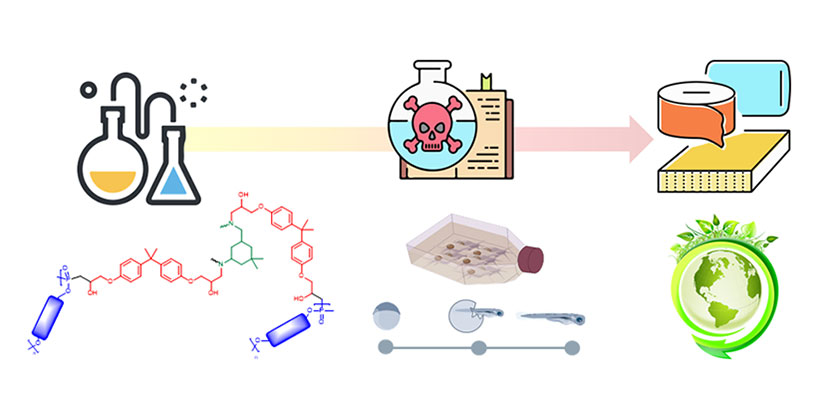
Experimental strategy for integrating aquatic toxicity considerations into development of Safe-and-Sustainable-by-Design materials (Graph: Ksenia Groh, Arvindh Sekar and needpix.com)
The Safe and Sustainable by Design (SSbD) framework was introduced by the European Commission (EC) in 2022 as a voluntary tool aiming to facilitate the “green” transition of chemical industry in Europe, in line with the EU’s Chemicals Strategy for Sustainability (CSS). While the SSbD framework offers an inspirational vision for reconciling chemical economy and environmental protection needs, practical experience with the application of the SSbD at the molecular design stage, or with its integration into material development routines, has been so far scarce. Thus, further progress on SSbD requires development of fit-for-purpose tools and design of smart workflows that enable efficient testing and incorporation of test results along the chemical and material innovation process.
We address these needs in the project “SSbD-vitrimers”, where we are collaborating with Empa-based chemists and material developers to co-develop a practical workflow for integrating aquatic toxicity considerations into the R&D process for polymeric materials, focusing on novel flame retardant vitrimers as a case study.
The project foresees developing an iterative workflow where in silico tools and standardized alternative (non-animal) tests for aquatic toxicity will be used to generate toxicity data for test materials. Collected toxicity data will be integrated with data on material properties and functions, in order to find the optimal composition and/or identify potential problems or further development needs, thus facilitating the next steps in material creation and optimization.
Apart from pursuing the outlined experimental strategy, this project also seeks to advance the conceptual understanding of the SSbD framework and its associated empirical testing needs.
array(4 items)0 => Snowflake\Publications\Domain\Model\Publicationprototypepersistent entity (uid=34987, pid=124)originalId => protected34987 (integer)
authors => protected'Leopold, A.; Bloor, M.; Groh, K.; Posthuma, L.; Sanderso n, H.; Schreiber, H.; Schür, C.; Thomas, P.' (140 chars)
title => protected'Research gaps and recommendations to improve the Safe and Sustainable by Des ign framework' (89 chars)
journal => protected'Integrated Environmental Assessment and Management' (50 chars)
year => protected2025 (integer)
volume => protected21 (integer)
issue => protected'4' (1 chars)
startpage => protected'735' (3 chars)
otherpage => protected'738' (3 chars)
categories => protected'' (0 chars)
description => protected'' (0 chars)
serialnumber => protected'1551-3777' (9 chars)
doi => protected'10.1093/inteam/vjaf059' (22 chars)
uid => protected34987 (integer)
_localizedUid => protected34987 (integer)modified_languageUid => protectedNULL
_versionedUid => protected34987 (integer)modifiedpid => protected124 (integer)1 => Snowflake\Publications\Domain\Model\Publicationprototypepersistent entity (uid=32823, pid=124)originalId => protected32823 (integer)
authors => protected'Posthuma, L.; Bloor, M.; Campos, B.; Groh, K.; Leopold,& nbsp;A.; Sanderson, H.; Schreiber, H.; Schür, C.; Thomas,&nb sp;P.' (157 chars)
title => protected'Green Swans countering chemical pollution' (41 chars)
journal => protected'Integrated Environmental Assessment and Management' (50 chars)
year => protected2024 (integer)
volume => protected20 (integer)
issue => protected'3' (1 chars)
startpage => protected'888' (3 chars)
otherpage => protected'891' (3 chars)
categories => protected'' (0 chars)
description => protected'If a problem has exponential features, its solution asks for counter-exponen tial approaches. Chemical pollution appears to be such a problem. Analyses o f chemical hazards to human health, biodiversity, and ecosystem services and estimates of the cost of inaction suggest the potential for adverse impacts , and analyses of trends in the chemical economy appear exponential in kind. Here, we argue that we need and can develop an exponential and application- focused mindset in thinking about solutions.' (500 chars)
serialnumber => protected'1551-3777' (9 chars)
doi => protected'10.1002/ieam.4915' (17 chars)
uid => protected32823 (integer)
_localizedUid => protected32823 (integer)modified_languageUid => protectedNULL
_versionedUid => protected32823 (integer)modifiedpid => protected124 (integer)2 => Snowflake\Publications\Domain\Model\Publicationprototypepersistent entity (uid=33402, pid=124)originalId => protected33402 (integer)
authors => protected'Leopold, A.; Bloor, M.; Campos, B.; Groh, K.; Posthuma,& nbsp;L.; Sanderson, H.; Schreiber, H.; Thomas, P.' (140 chars)
title => protected'SETAC–European Commission Green Deal Safe and sustainable by design consul tation series and anticipated end products' (118 chars)
journal => protected'SETAC Globe' (11 chars)
year => protected2024 (integer)
volume => protected0 (integer)
issue => protected'' (0 chars)
startpage => protected'(10 pp.)' (8 chars)
otherpage => protected'' (0 chars)
categories => protected'' (0 chars)
description => protected'' (0 chars)
serialnumber => protected'' (0 chars)
doi => protected'' (0 chars)
uid => protected33402 (integer)
_localizedUid => protected33402 (integer)modified_languageUid => protectedNULL
_versionedUid => protected33402 (integer)modifiedpid => protected124 (integer)3 => Snowflake\Publications\Domain\Model\Publicationprototypepersistent entity (uid=26237, pid=124)originalId => protected26237 (integer)
authors => protected'Groh, K. J.; Arp, H. P. H.; MacLeod, M.; Wang, Z.' (84 chars)
title => protected'Assessing and managing environmental hazards of polymers: historical develop ment, science advances and policy options' (117 chars)
journal => protected'Environmental Science: Processes and Impacts' (44 chars)
year => protected2023 (integer)
volume => protected25 (integer)
issue => protected'1' (1 chars)
startpage => protected'10' (2 chars)
otherpage => protected'25' (2 chars)
categories => protected'' (0 chars)
description => protected'Polymers are the main constituents of many materials and products in our mod ern world. However, their environmental safety is not assessed with the same level of detail as done for non-polymeric chemical substances. Moreover, th e fundamentals of contemporary regulatory approaches for polymers were devel oped in the early 1990s, with little change occurring since then. Currently, the European Commission is working on a proposal to initiate registration o f polymers under the European Union's (EU) chemicals legislation REACH. This provides a unique opportunity for regulation to catch up on recent scientif ic advances. To inform this process, we here critically appraise the suggest ed regulatory approaches to the environmental assessment and management of p olymers against the latest scientific findings regarding their environmental fate, exposure, and effects, and identify the remaining critical knowledge gaps. While we use the EU draft proposal as an example, our findings are bro adly applicable to other polymer legislations worldwide, due to the similari ty of polymer assessment criteria being used. We emphasize four major aspect s that require more attention in the regulation of polymers: (i) increased t ransparency about chemical identities, physical characteristics and grouping approaches for in-use polymers; (ii) improved understanding of the environm ental fate of polymers and materials composed of polymers across size and de nsity categories and exposure profiles; (iii) comprehensive assessment of th e environmental hazards of polymers, considering the effects of degradation and weathering and taking into account the actual uptake, long-term toxicity , and geophysical impacts; and (iv) consideration of the production volume a nd use/release patterns in determining regulatory data and testing requireme nts. Transitioning toward a toxic-free and sustainable circular economy will likely require additional policy instruments that will reduce the overall c omplexity and diversity ...' (2043 chars)
serialnumber => protected'2050-7887' (9 chars)
doi => protected'10.1039/D2EM00386D' (18 chars)
uid => protected26237 (integer)
_localizedUid => protected26237 (integer)modified_languageUid => protectedNULL
_versionedUid => protected26237 (integer)modifiedpid => protected124 (integer)
Leopold, A.; Bloor, M.; Groh, K.; Posthuma, L.; Sanderson, H.; Schreiber, H.; Schür, C.; Thomas, P. (2025) Research gaps and recommendations to improve the Safe and Sustainable by Design framework, Integrated Environmental Assessment and Management, 21(4), 735-738, doi:10.1093/inteam/vjaf059, Institutional Repository
Green Swans countering chemical pollution
If a problem has exponential features, its solution asks for counter-exponential approaches. Chemical pollution appears to be such a problem. Analyses of chemical hazards to human health, biodiversity, and ecosystem services and estimates of the cost of inaction suggest the potential for adverse impacts, and analyses of trends in the chemical economy appear exponential in kind. Here, we argue that we need and can develop an exponential and application-focused mindset in thinking about solutions.
Posthuma, L.; Bloor, M.; Campos, B.; Groh, K.; Leopold, A.; Sanderson, H.; Schreiber, H.; Schür, C.; Thomas, P. (2024) Green Swans countering chemical pollution, Integrated Environmental Assessment and Management, 20(3), 888-891, doi:10.1002/ieam.4915, Institutional Repository
Leopold, A.; Bloor, M.; Campos, B.; Groh, K.; Posthuma, L.; Sanderson, H.; Schreiber, H.; Thomas, P. (2024) SETAC–European Commission Green Deal Safe and sustainable by design consultation series and anticipated end products, SETAC Globe, (10 pp.), Institutional Repository
Assessing and managing environmental hazards of polymers: historical development, science advances and policy options
Polymers are the main constituents of many materials and products in our modern world. However, their environmental safety is not assessed with the same level of detail as done for non-polymeric chemical substances. Moreover, the fundamentals of contemporary regulatory approaches for polymers were developed in the early 1990s, with little change occurring since then. Currently, the European Commission is working on a proposal to initiate registration of polymers under the European Union's (EU) chemicals legislation REACH. This provides a unique opportunity for regulation to catch up on recent scientific advances. To inform this process, we here critically appraise the suggested regulatory approaches to the environmental assessment and management of polymers against the latest scientific findings regarding their environmental fate, exposure, and effects, and identify the remaining critical knowledge gaps. While we use the EU draft proposal as an example, our findings are broadly applicable to other polymer legislations worldwide, due to the similarity of polymer assessment criteria being used. We emphasize four major aspects that require more attention in the regulation of polymers: (i) increased transparency about chemical identities, physical characteristics and grouping approaches for in-use polymers; (ii) improved understanding of the environmental fate of polymers and materials composed of polymers across size and density categories and exposure profiles; (iii) comprehensive assessment of the environmental hazards of polymers, considering the effects of degradation and weathering and taking into account the actual uptake, long-term toxicity, and geophysical impacts; and (iv) consideration of the production volume and use/release patterns in determining regulatory data and testing requirements. Transitioning toward a toxic-free and sustainable circular economy will likely require additional policy instruments that will reduce the overall complexity and diversity of in-use polymers and polymeric materials.
Groh, K. J.; Arp, H. P. H.; MacLeod, M.; Wang, Z. (2023) Assessing and managing environmental hazards of polymers: historical development, science advances and policy options, Environmental Science: Processes and Impacts, 25(1), 10-25, doi:10.1039/D2EM00386D, Institutional Repository