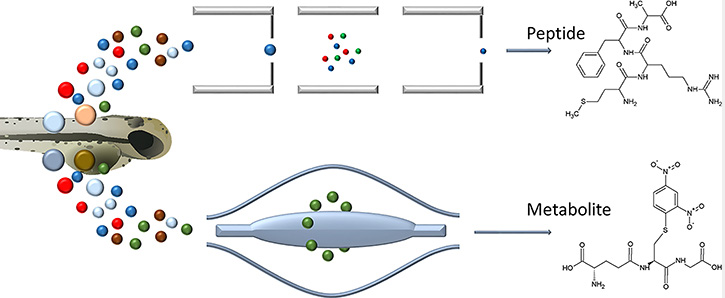
Analyse der GST Proteinen und Biotransformation Produkten in Zebrafisch (Bild: Alena Tierbach)
Die frühen Lebensstadien und Zelllinien des Zebrabärblings (Englisch: zebrafish; Danio rerio) sind als alternative Modelle für Toxizitätstests zur Untersuchung bioaktiver Verbindungen etabliert, sowohl in der Umwelttoxikologie als auch in der Humantoxikologie, wobei letzteres dank ihrer hohen genetischen Homologie zum Menschen möglich ist. Um jedoch die Zuverlässigkeit der mit diesen Modellsystemen durchgeführten Toxizitätsbewertung weiter zu verbessern, muss ihre Biotransformationskapazität besser verstanden werden.
Ein wichtiger Biotransformationspfad ist der Mercaptursäure Pfad, der an der Entgiftung elektrophiler Substanzen beteiligt ist. Bei einigen Substanzen kann dieser Pfad auch zu einer Aktivierung führen. Der erste Schritt im Mercaptursäure Pfad ist die Konjugation des Elektrophils mit Glutathion (GSH), die durch Glutathion-S-Transferase (GST) Enzymen katalysiert wird. Das Konjugat wird dann in das ausscheidbare Mercapturat umgewandelt. Unsere Arbeiten an Zebrafischembryonen sowie an der embryonalen Zelllinie PAC2 haben bestätigt, dass der Mercaptursäure Pfad in beiden Modellen funktionell ist, da wir die Expression eines breiten Repertoires an zytosolischen GSTs auf Proteinebene nachweisen und die Bildung der Biotransformationsprodukte innerhalb des Mercaptursäure Pfads unter Exposition gegenüber des Modellelektrophils CDNB demonstrieren konnten (beschrieben in den Publikationen von Tierbach et al.)
Derzeit arbeitet Veysel Demir mit den PAC2-Zellen des Zebrafisches, um zu untersuchen, ob die Expression von GST-Proteinen durch die Exposition gegenüber ihren Substraten reguliert wird. Sein Ziel ist es, die Folgen der Exposition gegenüber chemischen Mischungen, die diese Substanzen enthalten, besser zu verstehen.
array(4 items)0 => Snowflake\Publications\Domain\Model\Publicationprototypepersistent entity (uid=21420, pid=124)originalId => protected21420 (integer)
authors => protected'Tierbach, A.; Groh, K. J.; Schoenenberger, R.; Schirmer, K.; Suter, M. J. -F.' (117 chars)
title => protected'Characterization of the mercapturic acid pathway, an important phase II biot ransformation route, in a zebrafish embryo cell line' (128 chars)
journal => protected'Chemical Research in Toxicology' (31 chars)
year => protected2020 (integer)
volume => protected33 (integer)
issue => protected'11' (2 chars)
startpage => protected'2863' (4 chars)
otherpage => protected'2871' (4 chars)
categories => protected'' (0 chars)
description => protected'In view of the steadily increasing number of chemical compounds used in vari ous products and applications, high-throughput toxicity screening techniques can help meeting the needs of 21st century risk assessment. Zebrafish (<em> Danio rerio</em>), especially its early life stages, are increasingly used i n such screening efforts. In contrast, cell lines derived from this model or ganism have received less attention so far. A conceivable reason is the limi ted knowledge about their overall capacity to biotransform chemicals and the spectrum of expressed biotransformation pathways. One important biotransfor mation route is the mercapturic acid pathway, which protects organisms from harmful electrophilic compounds. The fully functional pathway involves a suc cession of several enzymatic reactions. To investigate the mercapturic acid pathway performance in the zebrafish embryonic cell line, PAC2, we analyzed the biotransformation products of the reactions comprising this pathway in t he cells exposed to a nontoxic concentration of the reference substrate, 1-c hloro-2,4-dinitrobenzene (CDNB). Additionally, we used targeted proteomics t o measure the expression of cytosolic glutathione S-transferases (GSTs), the enzyme family catalyzing the first reaction in this pathway. Our results re veal that the PAC2 cell line expresses a fully functional mercapturic acid p athway. All but one of the intermediate CDNB biotransformation products were identified. The presence of the active mercapturic acid pathway in this cel l line was further supported by the expression of a large palette of GST enz yme classes. Although the enzymes of the class alpha, one of the dominant GS T classes in the zebrafish embryo, were not detected, this did not seem to a ffect the capacity of the PAC2 cells to biotransform CDNB. Our data provide an important contribution toward using zebrafish cell lines, specifically PA C2, for animal-free high-throughput screening in toxicology and chemical haz ard assessment.' (1991 chars)
serialnumber => protected'0893-228X' (9 chars)
doi => protected'10.1021/acs.chemrestox.0c00315' (30 chars)
uid => protected21420 (integer)
_localizedUid => protected21420 (integer)modified_languageUid => protectedNULL
_versionedUid => protected21420 (integer)modifiedpid => protected124 (integer)1 => Snowflake\Publications\Domain\Model\Publicationprototypepersistent entity (uid=20722, pid=124)originalId => protected20722 (integer)
authors => protected'Tierbach, A.; Groh, K. J.; Schoenenberger, R.; Schirmer, K.; Suter, M. J. -F.' (117 chars)
title => protected'Biotransformation capacity of zebrafish (<em>Danio rerio</em>) early life st ages: functionality of the mercapturic acid pathway' (127 chars)
journal => protected'Toxicological Sciences' (22 chars)
year => protected2020 (integer)
volume => protected176 (integer)
issue => protected'2' (1 chars)
startpage => protected'355' (3 chars)
otherpage => protected'365' (3 chars)
categories => protected'biotransformation capacity; CDNB; GST; high-resolution mass spectrometry; ta rgeted proteomics; non-toxic concentration' (118 chars)
description => protected'Zebrafish (<em>Danio rerio</em>) early life stages offer a versatile model s ystem to study the efficacy and safety of drugs or other chemicals with rega rd to human and environmental health. This is because, aside from the well-c haracterized genome of zebrafish and the availability of a broad range of ex perimental and computational research tools, they are exceptionally well sui ted for high-throughput approaches. Yet, one important pharmacokinetic aspec t is thus far only poorly understood in zebrafish embryo and early larvae: t heir biotransformation capacity. Especially biotransformation of electrophil ic compounds is a critical pathway because they easily react with nucleophil e molecules, such as DNA or proteins, potentially inducing adverse health ef fects. To combat such adverse effects, conjugation reactions with glutathion e and further processing within the mercapturic acid pathway have evolved. W e here explore the functionality of this pathway in zebrafish early life sta ges using a reference substrate (1-chloro-2,4-dinitrobenzene, CDNB).<br /><b r />With this work we show that zebrafish embryos can biotransform CDNB to t he respective glutathione conjugate as early as 4 hours post fertilization . At all examined life stages, the glutathione conjugate is further biotrans formed to the last metabolite of the mercapturic acid pathway, the mercaptur ate, which is slowly excreted.<br /><br />Being able to biotransform electro philes within the mercapturic acid pathway shows that zebrafish early life s tages possess the potential to process xenobiotic compounds through glutathi one conjugation and the formation of mercapturates. The presence of this che mical biotransformation and clearance route in zebrafish early life stages s upports the application of this model in toxicology and chemical hazard asse ssment.<br /><br />' (1843 chars)
serialnumber => protected'1096-6080' (9 chars)
doi => protected'10.1093/toxsci/kfaa073' (22 chars)
uid => protected20722 (integer)
_localizedUid => protected20722 (integer)modified_languageUid => protectedNULL
_versionedUid => protected20722 (integer)modifiedpid => protected124 (integer)2 => Snowflake\Publications\Domain\Model\Publicationprototypepersistent entity (uid=20018, pid=124)originalId => protected20018 (integer)
authors => protected'Tierbach, A.; Groh, K. J.; Schönenberger, R.; Schirmer, K.; Suter, M. J. -F.' (117 chars)
title => protected'LC-APCI(-)-MS determination of 1-chloro-2,4-dinitrobenzene, a model substrat e for glutathione S-transferases' (108 chars)
journal => protected'Journal of the American Society for Mass Spectrometry' (53 chars)
year => protected2020 (integer)
volume => protected31 (integer)
issue => protected'' (0 chars)
startpage => protected'467' (3 chars)
otherpage => protected'472' (3 chars)
categories => protected'CDNB; GST activity; electron capture; APCI' (42 chars)
description => protected'1-Chloro-2,4-dinitrobenzene (CDNB) is widely used as a model substrate for m easuring enzyme activity of glutathione S-transferases in toxicity studies a nd in studies focusing on the metabol-ic capacity of different test systems. To allow the quantification of CDNB at low, non-toxic concentra-tions, we d eveloped a sensitive liquid chromatography-mass spectrometry (LC-MS) techniq ue, which is based on electron capture ionization using atmospheric pressure chemical ionization (APCI) in negative ion mode. Gas phase reactions occurr ing under atmospheric pressure produce specific ions that allow direct CDNB quantification down to 17 ng/ml in water. Using the new technique, we were a ble to verify CDNB exposure concentrations applied in two typical toxicity s tudies with early life stages of the com-mon model organisms, zebrafish (Dan io rerio) and a zebrafish embryonic cell line (Pac2).' (889 chars)
serialnumber => protected'1044-0305' (9 chars)
doi => protected'10.1021/jasms.9b00116' (21 chars)
uid => protected20018 (integer)
_localizedUid => protected20018 (integer)modified_languageUid => protectedNULL
_versionedUid => protected20018 (integer)modifiedpid => protected124 (integer)3 => Snowflake\Publications\Domain\Model\Publicationprototypepersistent entity (uid=16497, pid=124)originalId => protected16497 (integer)
authors => protected'Tierbach, A.; Groh, K. J.; Schönenberger, R.; Schirmer, K.; Suter, M. J. -F.' (117 chars)
title => protected'Glutathione S-transferase protein expression in different life stages of zeb rafish (<i>Danio rerio</i>)' (103 chars)
journal => protected'Toxicological Sciences' (22 chars)
year => protected2018 (integer)
volume => protected162 (integer)
issue => protected'2' (1 chars)
startpage => protected'702' (3 chars)
otherpage => protected'712' (3 chars)
categories => protected'GST; biotransformation; mass spectrometry; multiple reaction monitoring; tar geted proteomics' (92 chars)
description => protected'Zebrafish is a widely used animal model in biomedical sciences and toxicolog y. Although evidence for the presence of phases I and II xenobiotic defense mechanisms in zebrafish exists on the transcriptional and enzyme activity le vel, little is known about the protein expression of xenobiotic metabolizing enzymes. Given the important role of glutathione S-transferases (GSTs) in p hase II biotransformation, we analyzed cytosolic GST proteins in zebrafish e arly life stages and different organs of adult male and female fish, using a targeted proteomics approach. The established multiple reaction monitoring- based assays enable the measurement of the relative abundance of specific GS T isoenzymes and GST classes in zebrafish through a combination of proteotyp ic peptides and peptides shared within the same class. GSTs of the classes a lpha, mu, pi and rho are expressed in zebrafish embryo as early as 4 h postf ertilization (hpf). The majority of GST enzymes are present at 72 hpf follow ed by a continuous increase in expression thereafter. In adult zebrafish, GS T expression is organ dependent, with most of the GST classes showing the hi ghest expression in the liver. The expression of a wide range of cytosolic G ST isoenzymes and classes in zebrafish early life stages and adulthood suppo rts the use of zebrafish as a model organism in chemical-related investigati ons.' (1372 chars)
serialnumber => protected'1096-6080' (9 chars)
doi => protected'10.1093/toxsci/kfx293' (21 chars)
uid => protected16497 (integer)
_localizedUid => protected16497 (integer)modified_languageUid => protectedNULL
_versionedUid => protected16497 (integer)modifiedpid => protected124 (integer)
Characterization of the mercapturic acid pathway, an important phase II biotransformation route, in a zebrafish embryo cell line
In view of the steadily increasing number of chemical compounds used in various products and applications, high-throughput toxicity screening techniques can help meeting the needs of 21st century risk assessment. Zebrafish (Danio rerio), especially its early life stages, are increasingly used in such screening efforts. In contrast, cell lines derived from this model organism have received less attention so far. A conceivable reason is the limited knowledge about their overall capacity to biotransform chemicals and the spectrum of expressed biotransformation pathways. One important biotransformation route is the mercapturic acid pathway, which protects organisms from harmful electrophilic compounds. The fully functional pathway involves a succession of several enzymatic reactions. To investigate the mercapturic acid pathway performance in the zebrafish embryonic cell line, PAC2, we analyzed the biotransformation products of the reactions comprising this pathway in the cells exposed to a nontoxic concentration of the reference substrate, 1-chloro-2,4-dinitrobenzene (CDNB). Additionally, we used targeted proteomics to measure the expression of cytosolic glutathione S-transferases (GSTs), the enzyme family catalyzing the first reaction in this pathway. Our results reveal that the PAC2 cell line expresses a fully functional mercapturic acid pathway. All but one of the intermediate CDNB biotransformation products were identified. The presence of the active mercapturic acid pathway in this cell line was further supported by the expression of a large palette of GST enzyme classes. Although the enzymes of the class alpha, one of the dominant GST classes in the zebrafish embryo, were not detected, this did not seem to affect the capacity of the PAC2 cells to biotransform CDNB. Our data provide an important contribution toward using zebrafish cell lines, specifically PAC2, for animal-free high-throughput screening in toxicology and chemical hazard assessment.
Tierbach, A.; Groh, K. J.; Schoenenberger, R.; Schirmer, K.; Suter, M. J. -F. (2020) Characterization of the mercapturic acid pathway, an important phase II biotransformation route, in a zebrafish embryo cell line, Chemical Research in Toxicology, 33(11), 2863-2871, doi:10.1021/acs.chemrestox.0c00315, Institutional Repository
Biotransformation capacity of zebrafish (Danio rerio) early life stages: functionality of the mercapturic acid pathway
Zebrafish (Danio rerio) early life stages offer a versatile model system to study the efficacy and safety of drugs or other chemicals with regard to human and environmental health. This is because, aside from the well-characterized genome of zebrafish and the availability of a broad range of experimental and computational research tools, they are exceptionally well suited for high-throughput approaches. Yet, one important pharmacokinetic aspect is thus far only poorly understood in zebrafish embryo and early larvae: their biotransformation capacity. Especially biotransformation of electrophilic compounds is a critical pathway because they easily react with nucleophile molecules, such as DNA or proteins, potentially inducing adverse health effects. To combat such adverse effects, conjugation reactions with glutathione and further processing within the mercapturic acid pathway have evolved. We here explore the functionality of this pathway in zebrafish early life stages using a reference substrate (1-chloro-2,4-dinitrobenzene, CDNB).
With this work we show that zebrafish embryos can biotransform CDNB to the respective glutathione conjugate as early as 4 hours post fertilization. At all examined life stages, the glutathione conjugate is further biotransformed to the last metabolite of the mercapturic acid pathway, the mercapturate, which is slowly excreted.
Being able to biotransform electrophiles within the mercapturic acid pathway shows that zebrafish early life stages possess the potential to process xenobiotic compounds through glutathione conjugation and the formation of mercapturates. The presence of this chemical biotransformation and clearance route in zebrafish early life stages supports the application of this model in toxicology and chemical hazard assessment.
Tierbach, A.; Groh, K. J.; Schoenenberger, R.; Schirmer, K.; Suter, M. J. -F. (2020) Biotransformation capacity of zebrafish (Danio rerio) early life stages: functionality of the mercapturic acid pathway, Toxicological Sciences, 176(2), 355-365, doi:10.1093/toxsci/kfaa073, Institutional Repository
LC-APCI(-)-MS determination of 1-chloro-2,4-dinitrobenzene, a model substrate for glutathione S-transferases
1-Chloro-2,4-dinitrobenzene (CDNB) is widely used as a model substrate for measuring enzyme activity of glutathione S-transferases in toxicity studies and in studies focusing on the metabol-ic capacity of different test systems. To allow the quantification of CDNB at low, non-toxic concentra-tions, we developed a sensitive liquid chromatography-mass spectrometry (LC-MS) technique, which is based on electron capture ionization using atmospheric pressure chemical ionization (APCI) in negative ion mode. Gas phase reactions occurring under atmospheric pressure produce specific ions that allow direct CDNB quantification down to 17 ng/ml in water. Using the new technique, we were able to verify CDNB exposure concentrations applied in two typical toxicity studies with early life stages of the com-mon model organisms, zebrafish (Danio rerio) and a zebrafish embryonic cell line (Pac2).
Tierbach, A.; Groh, K. J.; Schönenberger, R.; Schirmer, K.; Suter, M. J. -F. (2020) LC-APCI(-)-MS determination of 1-chloro-2,4-dinitrobenzene, a model substrate for glutathione S-transferases, Journal of the American Society for Mass Spectrometry, 31, 467-472, doi:10.1021/jasms.9b00116, Institutional Repository
Glutathione S-transferase protein expression in different life stages of zebrafish (Danio rerio)
Zebrafish is a widely used animal model in biomedical sciences and toxicology. Although evidence for the presence of phases I and II xenobiotic defense mechanisms in zebrafish exists on the transcriptional and enzyme activity level, little is known about the protein expression of xenobiotic metabolizing enzymes. Given the important role of glutathione S-transferases (GSTs) in phase II biotransformation, we analyzed cytosolic GST proteins in zebrafish early life stages and different organs of adult male and female fish, using a targeted proteomics approach. The established multiple reaction monitoring-based assays enable the measurement of the relative abundance of specific GST isoenzymes and GST classes in zebrafish through a combination of proteotypic peptides and peptides shared within the same class. GSTs of the classes alpha, mu, pi and rho are expressed in zebrafish embryo as early as 4 h postfertilization (hpf). The majority of GST enzymes are present at 72 hpf followed by a continuous increase in expression thereafter. In adult zebrafish, GST expression is organ dependent, with most of the GST classes showing the highest expression in the liver. The expression of a wide range of cytosolic GST isoenzymes and classes in zebrafish early life stages and adulthood supports the use of zebrafish as a model organism in chemical-related investigations.
Tierbach, A.; Groh, K. J.; Schönenberger, R.; Schirmer, K.; Suter, M. J. -F. (2018) Glutathione S-transferase protein expression in different life stages of zebrafish (Danio rerio), Toxicological Sciences, 162(2), 702-712, doi:10.1093/toxsci/kfx293, Institutional Repository